Recent record-high reports on new active COVID-19 cases show that the pandemic is far from over. Even the slight decrease in transmission in Metro Manila offers little comfort, as other regions brace and prepare for a possible surge.
In Mindanao, for example, local governments have expressed fatigue and dwindling resources to respond effectively to the pandemic, on top of other emergencies such as natural hazards, protracted conflict, and climate risks.
As hospital beds run out, people are lining up in makeshift tents with some of them dying while waiting for their turn to be admitted. Overwhelmed health workers, insufficient space for treatment and isolation, and financial difficulty call for alternative and cost-efficient solutions.
From Alternative Temporary Shelters to Community Quarantine Facilities
At the onset of the pandemic, local government partners of the Moving Urban Poor Communities in the Philippines toward Resilience (MOVE UP) Project were aware that the rising cases and lack of medical resources and spatial capacity could pose grave consequences in densely populated cities.
In an effort to complement government response, the MOVE UP project along with partners such as the Czech Republic Humanitarian Aid and United Architects of the Philippines – Emergency Architects worked together to adapt Alternative Temporary Shelters (ATS) into quarantine facilities.
Despite mobility constraints and other health measures, the first Community Quarantine Facility adapted from ATS models was turned over in Malabon City on 18 June 2020, and received DOH certification in the same week. The experience in opening the 38-bed-capacity of the amphitheater still in operation has provided valuable lessons in replication of the strategy in other areas in Malabon and also in Mindanao.
Following the same strategy, community quarantine facilities were also set up by the local governments of Bukidnon, Misamis Oriental, Cagayan de Oro, Tandag City, and Surigao del Sur with support from MOVE UP and REACH projects.
Read the full story by accessing the file in this link.
The Moving Urban Poor Communities Toward Resilience (MOVE UP) Project is funded by EU Civil Protection & Humanitarian Aid – ECHO and is implemented by ACCORD Incorporated, Action Against Hunger Philippines, CARE Philippines, and Plan International Philippines.
The INCREASE Project has committed to holding four (4) learning exchanges engaging local implementing partners and partner communities across provinces to share DRR CCA / IRM good practices, ideas for sustainability and upscaling, innovations, and evidence from which these are based.
Similarly, the project has also committed to producing four (4) research briefs/communication materials, or case stories, from DRR CCA / IRM good practices and innovations documented to be published through RILHUB.
This partner-level learning exchange is the second part of the INCREASE Cross-Learning Platform for Resilience-Building Session 2. The learning questions raised to partners are the following:
What risk reduction and climate change adaptation measures have the FHH/farmers adopted during the project period?
What are the indigenous and modern farming practices that you have adopted throughout the years, and which among these do you plan to continue?
How does livelihood diversification help individuals and communities reduce risks and reduce negative coping mechanisms?
What factors drive women and men farmers’ and fishers’ adoption of climate-informed practice, and resilient livelihood strategies?
What encourages incentivises them to be flexible to change, and become more open to becoming part of forward-looking assessments?
To access a soft copy of this presentation deck, please click here.
INCREASE or “Philippines – Increasing Resilience to Natural Hazards” aims to aims to increase the resilience of 45,00 women and men small scale farmers and fishers, including 720 extremely poor female-headed households, to natural hazards and the effect of climate change. The project will run from 2019-2021 in different parts of the Philippines, namely 36 barangays across 8 municipalities in the provinces of Cagayan, Mt. Province, Northern Samar, and Surigao del Sur. Its project components and activities include early warning systems, alternative livelihood, and climate and disaster governance.
In the time of the COVID-19 Pandemic, many of the resilience- and capacity-building efforts of different organizations and programs have been hampered by existing and constantly changing logistical restrictions and health protocols such as travel and face-to-face meeting prohibitions.
In lieu of earthquake drills, in what other ways can we simulate unprecedented risks in our community? In what ways can we continue incapacitating our local governments, our leaders, and our community members to be able to efficiently and aptly respond to emerging risks and disasters?
Tabletop exercises are one way that CARE and ACCORD projects have been training their stakeholders. To learn more about how to conduct this exercise remotely as an adaptive measure to the pandemic, you may check out the Remote Mock Tabletop Exercises brief introduction below.
To access a soft copy of the said material, please click this link.
The Moving Urban Poor Communities in Mindanao towards Resilience Project (MOVE UP Mindanao) is an urban resilience project which aims to contribute to the resilience building of urban poor populations to withstand and manage the impact of disasters. It aims to strengthen urban disaster preparedness, response, and management capacity of the national, sub-national, and local government units (LGUs), and other stakeholders through the adaption and/or replication of tested urban resilience strategies.
MOVE UP- Mindanao project advocates, among others, the strengthening of shock responsive social protection mechanisms to help reduce vulnerability and support timely recovery in the event of shocks and stresses.
In partnership with the Department of Interior and Local Government – Local Government Academy, the project aims to share its lessons learned, good practices, and innovations gathered and tested from its experience in working with urban poor communities to contribute to the large-scale resilience-building effort.
MOVE UP- Mindanao is implemented by a consortium of international non-government organizations which includes Plan International Philippines, Action Against Hunger, and CARE Philippines with its local partner ACCORD Inc. Funded by the European Civil Protection and Humanitarian Aid Operations (ECHO), the project is currently implementing in 9 LGUs in Mindanao.
BACKGROUND OF THE SESSION
Effective social protection is critical to reduce vulnerability and support timely recovery. However, to date, national systems have been too underdeveloped or not flexible enough to allow them to expand before or during emergencies.
This webinar will discuss the basic concepts of shock-responsive social protection and the MOVE UP projects strategies in its goal to help LGUs strengthen their social protection mechanisms to respond to and recover from shocks and stresses.
This webinar will also share some good practices at the local level in implementing anticipatory action strategies in the context of disaster risk reduction and management.
This session was aimed at the following objectives:
1. Provide an overview on the basic concepts of shock-responsive social protection; and
2. Share good practices in implementing Disaster Risk Reduction and Management strategies in the context of social protection from local experiences.
These presentations used during this learning session are as follows:
The Urban Resilience Model and Basic Concepts of Shock-Responsive Social Protection
by Mr. Roger Cabiles, Head of Project and Consortium Manager, MOVE UP-Mindanao Project, Action Against Hunger Philippines
This presentation describes the MOVE UP project’s Urban Resiliennce Model, its tried and tested model for disaster resilience developed through years of working with urban poor communities and local government units. It also explores the basic concepts of shock-responsive social protection, its difference to social protection, basic social services, disaster response, and the legal bases and frameworks which support its implementation. Moreover, the interconnectedness of these two strategies is also explored.To access a copy of this presentation, please click this link.
BREADY Project Presentation by Mayor Melchor Llego Mergal, Municipal Mayor, Salcedo, Eastern SamarThis presentation shares the inspiring and good practice of Salcedo, Eastern Samar in the implementation of its pre-emptive cash transfer program with the help of the BREADY Project by Oxfam and Plan International Philippines. Mayor Melchor Mergal shares the processes they’ve undergone to implement the program, including their realizations and challenges.
To access a copy of this presentation, please click this link.
SRSP Synthesis
by Mr. Arnel Sanchez, Social Protection Specialist, MOVE UP – Mindanao Project, Plan International PhilippinesThis presentation summarizes the points raised during the webinar and highlighted certain challenges in the implementation of shock-responsive social protection projects in the Philippines.To access a copy of this presentation, please click this link.
The 2020 Alternative Temporary Shelter (ATS) Manual is an initiative of the Moving Urban Poor Communities in the Philippines toward Resilience (MOVE UP) Project. This manual is intended for new and experienced users with zero to advanced ATS System and shelter response knowledge. This manual aims to describe the importance and practical applications of ATS and offer step-by-step guidance on properly adopting and implementing select ATS solutions as a form of shelter response and early action during emergencies. This manual provides guidance to local government units, civil society organizations, community members, and other stakeholders on addressing the immediate shelter needs of internally displaced populations (IDPs) within a 24- hour to 36-hour period after a disaster and even for long-term displacements while conforming with universally accepted humanitarian principles and standards. This manual is a working document and shall be updated from time to time.
Target Users
This manual is principally intended for local government units (LGUs) and communities to augment their shelter response and early action capacities during emergencies. The manual also targets the private sector, civil society organizations (CSOs), humanitarian organizations, and other actors working closely with communities to build their resilience.
To view and download a complete copy of this document, please click here.
by Tanya Mariano, ACCORD, Inc
This report is based on CARE and ACCORD’s partnership with communities, PAGASA, and PHIVOLCS in previous projects implemented using Integrated Risk Management, and which received support funding from the European Civil Protection & Humanitarian Aid Operations (ECHO) and the Partners for Resilience project.
Natural hazards, climate change, and unrestrained ecosystem degradation are spawning extreme events, resulting in massive losses of lives and livelihoods.
Early warning systems (EWS) are crucial in reducing the risks to which vulnerable communities are exposed: effective ones can save countless lives and livelihoods, and less effective ones can turn hazards into disasters and extreme events.
It can provide the opportunity for individuals, communities, governments, businesses, and others to take timely action to reduce risks in advance of hazardous events. This, in turn, contributes to building community resilience. But for an EWS to be effective, it needs to be end-to-end, people-centered or community-based, and landscape-wide.
Community-based refers to an EWS that gives premium to community participation and ownership of the system. A landscape approach means it encompasses larger landscapes such as river basins or watersheds. This requires the harmonization of systems within a landscape, and cooperation among political and administrative units sharing the same landscape.
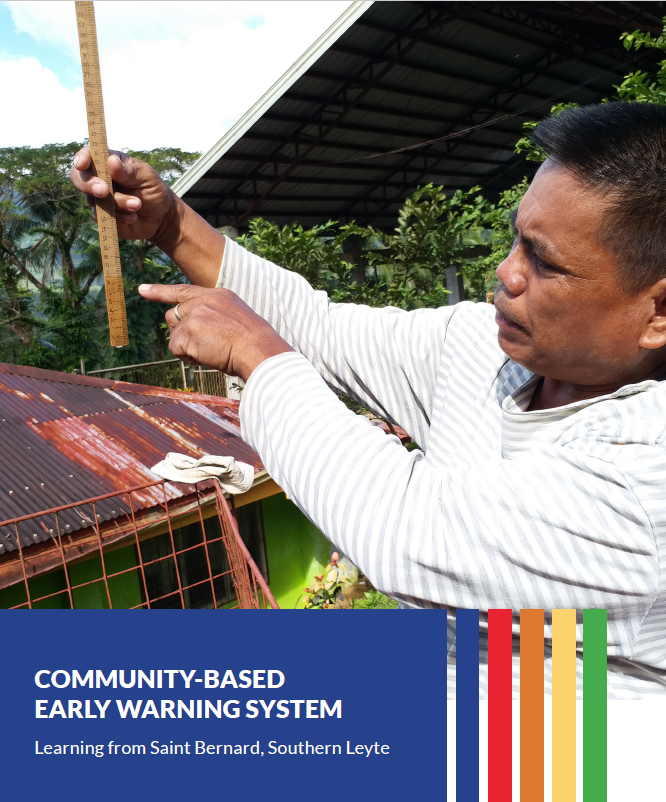
In the municipality of Saint Bernard in the province of Southern Leyte, the setting up of the EWS, among other DRR and climate change adaptation actions, was occasioned by a landslide that wiped out an entire barangay (village) in 2006. The event underscored the municipality’s vulnerability to multiple hazards and the urgent need to improve preparedness.
Through the collaboration of the municipal LGU, government agencies, civil society organizations, and community members, the EWS was instituted. In 2013, their community-based local flood EWS was recognized by the UN Sasakawa Award for Disaster Reduction for its innovative approach that combines technology and comprehensive social preparation. It was one of six projects from around the world that received the award.
This study presents Saint Bernard’s experiences and lessons learned in setting up and managing the end-to-end, community-based, and landscape-wide EWS for floods, landslides, and tsunamis.
This quote is a truism that the indigenous people of the Cordillera have asserted time and again as they struggled to develop and live in the mountainous terrain that has been their homeland since time immemorial. By living closely with their environment, they have been able to accumulate indigenous knowledge and practices that guide every aspect of their lives. These practices and knowledge such as the appearance of a certain animal or plant, the behaviour of pets, the color of the sky and many others that signal the occurrence of a certain phenomena have also been pivotal in helping them cope with and bounce back from hazards and disasters they have faced throughout the years. However, the changing climate has made it difficult for the communities. They have struggled to apply the knowledge that has served them well for a long time. Today, very rare is the instance where the appearance of a certain migratory bird can signal the onset of strong rains or a typhoon.
Sitio Mangagew is just one of the 12 communities in the Cordillera where the Partners for Resilience (PfR) programme is being implemented. From the town proper in Bokod, Benguet, it can be reached by a two hour hike or an hour’s drive through a muddy, rutted road that is impassable during the rainy season. It is mainly inhabited by the Ibalois, one of the major ethno-linguistic groups in the Cordillera.
The community members derive their livelihood from planting rice and other vegetables, the majority of which are rain-fed. But recently, the community has reported a steady decline in rice and vegetable production due to the lack of rains leading to reduced water supply especially during the summer months. Based on climate projections for the region, or the years 2020 and 2050, rainy seasons will be wetter, summers will be drier and the whole year will be hotter 0.9 degrees Celsius. Climate change has also escalated the uncertainties in the communities’ agricultural production as the increased occurrence, intensity, and length of rainfall events—which consequently increase erosion rates, trigger landslides, and make certain crops susceptible to diseases—have impacted crop production in the community.
These climate projections, in combination with the indigenous knowledge and practices of the community and ecosystem information have been the starting point for the Cordillera Disaster Response and Development Services (CorDisRDS), a local partner of CARE Nederland, in implementing the PfR programme. The approach by CorDisRDS has been to supplement scientific information with local knowledge in all steps of implementation from the community risk assessment to contingency planning at the local government level in order to gain a comprehensive picture of the local situation. The climate projections in particular have been especially important in designing small-scale mitigation (SSM) projects for the communities. SSM projects are interventions that aim to reduce vulnerabilities through strengthening, diversifying or protecting livelihoods.
For Sitio Mangagew, due to the observed decrease in water supply and long-term projection of drier summers, CorDisRDs and the community agreed to build a communal water system as their SSM. The aim of the project was to provide a steady supply of water that can be used for both irrigation and domestic purposes thereby strengthening agricultural production. After consultations and planning with the local government unit and peoples’ organization, work began. A site was carefully selected ensuring that no damage will be done to the environment.
Community members of Sitio Mangagew working together to construct the distributor tank for their water system.
Materials were carried four kilometres and the whole community relied on their traditional practice of “gamal” or cooperative endeavour to provide labour.
Since the water source was located two kilometres away and one had to pass through a river to reach it, the plastic pipes needed to bring the water to the community were fastened to steel cables that stretched from the water source across the river to the sitio center. The community worked steadily for one month while balancing their economic activities in order to complete the project. Even the families who were not direct beneficiaries pitched in. Finally, on September 2014, the community installed the final plastic pipe. It took two months of hard work but the hope of having a steady water supply was closer to reality.
Today, the community is enjoying the benefits of their hard work. The water system is fully functional and is being used for irrigating the newly planted rice.
“We are very thankful to CorDis RDS and CARE through the PfR programme for providing us support to construct our water system. Our sitio is rarely visited by other people. At first we were hesitant to participate in the project because we had a hard time understanding the concepts being introduced. We felt that our practices were enough to protect us from disasters but we soon came to understand the importance accepting new ideas because our traditional knowledge may not be applicable all the time. ” said Victorio Agustin, a village leader, while proudly showing the completed tank full of water to be distributed to the different households.
It is always a challenge when working with a community that has a deeply-rooted belief system because they may be hesitant to accept new ideas and concepts thinking that their own traditional knowledge is sufficient. But Sitio Mangagew is an example of how the scientific data including climate projections and ecosystem data in conjunction with indigenous knowledge and practices can be effectively used to build safer and resilient communities.
Johari Cali is a playful boy with a shy smile. He is a Grade 4 pupil at the Mandulog Elementary School. He lives in Purok 21 of barangay Mandulog. Purok 21, together with Purok 18 and Purok 22, are separated from the rest of the barangay by Bayug River.
Along with the other children in the community, Bayug River is Joharis’s playground. The river serves as their bathing place where they can swim until sundown. It is also in this river they get water for washing and drinking. Often, Joharis helps in household responsibilities by drawing water from the river. For Joharis, his family, and his neighbours, the river is everything.
Joharis’s family’s house is located just beside the old Pigsu-otan concrete bridge. This bridge connects the three puroks of Mandulog, as well as barangay Lanipao, Dulag and Kalilangan to the rest of Mandulog and Iligan City. Along with his other siblings, they walk for over a kilometre everyday in going to school. “My mother is very insistent that we never miss school. She would always tell us that it is hard if we are not educated. Better opportunities would rarely come way and would even be discriminated because of lack of education. My mother would say that education is the only gift I could give to us her children,” relates Joharis in the Maranao language. Arlene, or Inday to her neighbours, herself did not finish elementary grades.
In the night of 17 December 2011, 2011 the river that used to be the children’s playground and the source of life to the community claimed many lives and destroyed a large amount of property in Joharis’s community.
Joharis’s eyes still widen as he recalls what he witnessed: “that night, the river widened, overflowing its banks. The current was so strong. I have never seen the river so angry. Our neighbours were in panic as they sought refuge in our house.”
Eventually, Joharis’s family had also to abandon its house. His Nanay Inday courageously gathered all her seven children and transferred to another house for safety. Keeping her children intact was all she could do as she heard the river’s strong current away the concrete bridge that connects them to the outside world.
The young Johari together with his parents and siblings immediately started rebuilding their lives after the storm. They were among the lucky ones whose houses were not carried away by the deadly floods. But Swaib, Joharis’s father remained depressed for the coconuts that he was about to harvest were either washed away by the flood, or the flowers and nuts were blown away by the strong wind. For a time, the family experienced hunger. “We had only porridge and root crops,” reveals Joharis. Help that came is like a blessing that Allah delivers to them.
Trying to go back to their normal lives, Johari continued going to school when it reopened. However, it was very difficult because since the concrete bridge that they used to cross was washed away by the floods, Johari and his siblings had to use a makeshift bamboo raft to cross the river in order to go to school. Her mother feared that accidents might happen, but could not do anything since there is no other way for the children to go to school except to take the raft. During rainy days, when the river is swollen, Joharis’s mother would not let the children go to school. Thus, most of the time the children were absent. “My mother would not allow us to go to school when the river is swollen and the current is very strong. I also feel afraid at times, Johari relates.
“I have stopped wearing my shoes in going to school. It gets wet during the ride on the raft. I also wrapped my books and notebooks in plastic bags so that they will not get wet should it rain or the raft capsize when the current is strong.”
On the way home from school Joharis and his siblings would always stop for a while and watch adult members of the community build a footbridge across Bayug River. They were overjoyed when the footbridge could already be used. Even if work on the bridge was not yet completed, with some community members still doing some paintwork, they were already allowed to use the bridge. Asked what the footbridge meant to him, Joharis said: “We no longer have to be absent from school when it rains hard. We no longer fear that the river’s strong currents would carry us away. My books and notebooks will no longer get wet. Now I can wear again my shoes to school.” There joy in Joharis’s eyes as he crosses back and forth the footbridge along with the other children, tugging with them their toy carts. Perhaps, crossing the bridge of hope somehow eases the sad memory brought by the storm. Now according to Johari, he can go to school running and he can now wear his shoes to school. And walks to school with a smile.
Rationale of the Resilience Knowledge Exchnage Series Session 6 Webinar:
The COVID-19 pandemic has brought pervasive fears and new policies that change our way of life. As local efforts and hopes center on contact tracing and finding a vaccine, little attempts have been undertaken to view the environment in direct relation with COVID-19.
The environment is ultimately interconnected with mankind. Its degradation affects the quality of life of all individuals and living beings on earth. Locally, there has been no significant inquiry into how the environment, especially its degradation, might have influenced the pandemic. Neither is there any grand investigation on how the pandemic has affected the environment in turn. Could certain signs detected from environmental patterns and elements point us to the trends, causes, and cures of the pandemic? This question remains unasked, and therefore, unanswered.
The COVID-19 and the Environment webinar attempts to address this question, as two researchers discuss the impact of environmental degradation on the pandemic, including the current research and proposed projects in monitoring COVID-19. One such research focuses on waterways as early warning systems or a monitoring system for disease detection, especially for COVID-19. The other research centers on hazardous waste for the same purpose.
Though similar proposals have already been implemented internationally, no such research inquiry has been localized yet. Through this research, monitoring will be much more efficient, as specific areas and focus will be detected earlier.
Discussing innovative perspectives and tools offers us an alternative way of assuaging anxieties during this time of crisis. At the same time, it helps widen our understanding to include elements previously thought to be lateral but are actually quite essential: the environment.
The presentation on wastewater-based monitoring for predicting pandemics and outbreaks aims to explain the concept, importance, and potential of the said topic. This presentation was created and presented by Dr. Marilen Parungao Balolong, DRPH, DPAM, Professor and University Scientist at the University of the Philippines Manila.
To access a soft copy of this material, click here.
A couple of years ago, the Philippines made headlines around the world as Typhoon Haiyan, the strongest storm recorded, smashed ashore and tore through the Visayas. Within 24 hours, Haiyan battered and wiped out almost everything along its path, leaving behind its wake millions of people homeless, and thousands lifeless. The full document details how communities were slowly starting to reap the sowed resilience two years after the typhoon.
While the scale and strength of Haiyan is unprecedented even in a disaster-prone country as the Philippines, disasters like this are becoming more frequent, destructive, and unpredictable as a result of climate change and ecosystem degradation. Disaster upon disaster, vulnerable communities are pushed deeper into poverty. They are ones who face the vicious cycle of destruction and reconstruction. Their vulnerabilities are magnified, and their developments stalled. It is therefore not enough for communities to recover from Haiyan’s destruction. They must be able to withstand, adapt to, and recover from disasters. It is imperative that they start rebuilding towards resilience.
In the immediate aftermath of Haiyan, ACCORD in partnership with CARE, drew opportunities from lessons brought by Haiyan to cultivate resilience. From the onset, seeds of resilience were sown where possible, both in the form of material assistance and building local capacities, and embedded in integrated response, recovery, rehabilitation, and risk reduction programmes for Haiyan-affected areas.
Two years on, much remains to be done, but vulnerable communities are beginning to reap the fruits of resilience.

 Along with the other children in the community, Bayug River is Joharis’s playground. The river serves as their bathing place where they can swim until sundown. It is also in this river they get water for washing and drinking. Often, Joharis helps in household responsibilities by drawing water from the river. For Joharis, his family, and his neighbours, the river is everything.