After a string of powerful typhoons swept across the Philippines from September to November 2024: a father rebuilds, a grandmother provides, a man with disability survives days stranded on his roof. In the country’s southernmost island, amid conflict and compounding disasters, people continue to hope.
These are stories of survival and strength, from Batangas, Nueva Ecija, Camarines Sur, and Mindanao, from communities supported by timely, dignified humanitarian aid.
Gathered through the EU Humanitarian Aid-funded ACCESS Project.
Contents:
Mindanao in Focus: Resilience in the Margins, Hope at the Center (a photo collection)
A Father’s Strength to Rebuild His Life After a Super Typhoon (story by Action Against Hunger Philippines)
Weathering Storms & Scarcity: A Grandmother’s Life After Typhoon Yagi (story by CARE Philippines)
Holding On: Antonio’s Fight for Survival & Hope (story by Save the Children Philippines)
A collection of stories on peace, progress, and recovery: a tribal community ending two decades of armed conflict, remote villages transformed by access to clean water, families rebuilding safer homes after a storm.
These stories of change were made possible through the ACCESS and BRIDGE projects, funded by European Union Humanitarian Aid.
Contents:
Talaandig Tribe’s 20 Year Journey to Peace (story by ACCORD and CARE Philippines)
Empowering Remote Villages with Accessible Water (story by Action Against Hunger Philippines)
Building Back Safer After Super Typhoon Egay (story by ACCORD and CARE Philippines)
Two years into the COVID-19 pandemic, the Philippines is still experiencing challenges in surpassing limitations and challenges — both new and exacerbated existing ones. However, it seems that one positive note is that in certain areas in the country, vaccine hesitance or resistance is slowly diminishing. Undoubtedly, this is not solely due to mainstream media and hearsay, but also because of the valuable contributions of community representatives, volunteers, and workers.
In some barangays in Pulilan, Baliuag, and Malolos, Bulacan, Community Health Educators or CHEs work hand-in-hand with the local government, particularly at the barangay level to engage the community and assure that they are being informed of updates for protocols, current response efforts from different sectors fo society, and most importantly the availability of services and vaccinations around their area.
A Community Health Educator Disseminating an RCCE material among citizens in line to get their vaccine. | Photo by: Leigh Fuentes, CARE Philippines
Mary Jean Santos , 46, Resident of Pulilan, Bulacan and attendee of one of the RCCE seminars on COVID-19 vaccination.
Mary Jean Santos, 46, a resident in Pulilan, Bulacan, shared how she was extremely against getting the vaccine before. She had gotten word of different stories and hearsay that the vaccine would provide more harm than benefit, possibly even causing death. However, upon the encouragement of one of the barangay volunteer CHEs, Mary Jean was invited and attended a seminar that helped educate citizens on accurate information regarding COVID-19 vaccination. After learning that most, if not all of her prior prejudices on getting vaccinated were false, she was vaccinated last December 2021.
“Ngayon alam ko nanakailanganpala ng bakuna kasi kailangan natin ng protekshyon at saka para rinsamgakasamasabahayat patinarinmgamahal natin sabuhay.” [I only found out recently that we really do need vaccines since we not only need protection for ourselves, but also protection for the sake of our households and loved ones.]
CHE Fe Jumagdao discussing plans during the rollout of the Libreng Sakay Activity with CARE Philippines, Southern Tagalog People’s Response Center, MINCODE, and Cargill.
Community Health Educators such as Fe Jumagdao, also shared that aside from encouraging citizens to get vaccinated, it is also helpful to encourage the community to share their concerns and questions with their local government since it is also their right. CHE Syrlle Ann Ginooalso recounted her experiences in speaking with her fellow community members, with people fearing possible side effects of the vaccine, even hearing stories that some worried getting vaccinated would only allow them up two more years to live. Furthermore, since she believed the CHEs learned many facts from working with the health professionals and barangay officials, she strongly encouraged the participation of community members to take advantage of Risk Communication and Community Engagement (RCCE) efforts like resources and seminars made available through partnerships with both the private and humanitarian sector.
CHE Leny Ventura from Brangay. Pinagbarilan
“Malaki ang naging tulong ng saminar dahil nga naunawaan nila, bukod sa kakasabi namin,” says Leny Ventura, another CHE from Brgy, Pinagbarilan, Baliuag, Bulacan. [The seminar was really a big help since it provided people an avenue to better understand the situation aside from jus t us CHEs repetitively telling them.]
CHE Syrille Ann Ginoo from Brangay. Pinagbarilan
Among other volunteers at the barangay level, Evelyn Paltao, a mother Leader in Barangay Tarcan highlighted that it is also important for local leaders and volunteers to be examples of practicing proper health protocols and movement in the community in order to further strengthen and assure their local safety and progress toward recovery and herd immunity.
With continued perseverance paired with government assistance, collaborative partnerships among different sectors of society, and the open-mindedness of the community people, the CHEs in these communities are among many of those who work hard and strive for a more positive and healthy population.
The RCCE and Vaccination Roll-Out Project, which is being implemented in Malolos City, Baliwag and Pulilan in Bulacan Province, Sto. Tomas City in Batangas, and General Santos City in South Cotabato, aims to support 30 barangay local government units (BLGUs) to increase their capacities in implementing COVID-19 policies and help encourage their residents to get vaccinated. More than 2,450 barangay officials, health workers and members of the peacekeeping team have already been trained by medical professionals to further spread information and provide communication about the risks of COVID-19 and vaccination benefits. This initiative is a collaboration between CARE Philippines, the Southern Tagalog People’s Response Center, MINCODE, and Cargill.
by Tanya Mariano, ACCORD, Inc
This report is based on CARE and ACCORD’s partnership with communities, PAGASA, and PHIVOLCS in previous projects implemented using Integrated Risk Management, and which received support funding from the European Civil Protection & Humanitarian Aid Operations (ECHO) and the Partners for Resilience project.
Natural hazards, climate change, and unrestrained ecosystem degradation are spawning extreme events, resulting in massive losses of lives and livelihoods.
Early warning systems (EWS) are crucial in reducing the risks to which vulnerable communities are exposed: effective ones can save countless lives and livelihoods, and less effective ones can turn hazards into disasters and extreme events.
It can provide the opportunity for individuals, communities, governments, businesses, and others to take timely action to reduce risks in advance of hazardous events. This, in turn, contributes to building community resilience. But for an EWS to be effective, it needs to be end-to-end, people-centered or community-based, and landscape-wide.
Community-based refers to an EWS that gives premium to community participation and ownership of the system. A landscape approach means it encompasses larger landscapes such as river basins or watersheds. This requires the harmonization of systems within a landscape, and cooperation among political and administrative units sharing the same landscape.
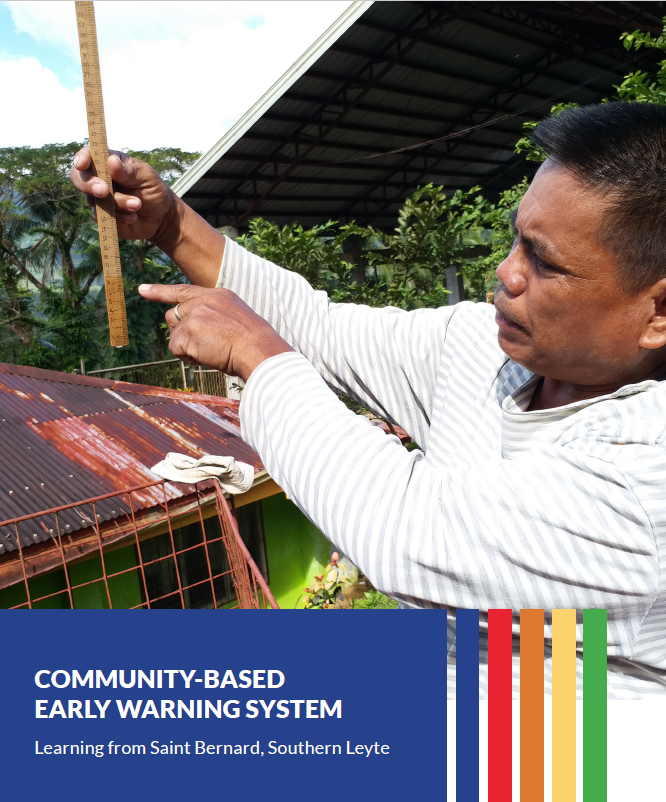
In the municipality of Saint Bernard in the province of Southern Leyte, the setting up of the EWS, among other DRR and climate change adaptation actions, was occasioned by a landslide that wiped out an entire barangay (village) in 2006. The event underscored the municipality’s vulnerability to multiple hazards and the urgent need to improve preparedness.
Through the collaboration of the municipal LGU, government agencies, civil society organizations, and community members, the EWS was instituted. In 2013, their community-based local flood EWS was recognized by the UN Sasakawa Award for Disaster Reduction for its innovative approach that combines technology and comprehensive social preparation. It was one of six projects from around the world that received the award.
This study presents Saint Bernard’s experiences and lessons learned in setting up and managing the end-to-end, community-based, and landscape-wide EWS for floods, landslides, and tsunamis.
When lockdown measures were implemented to prevent the spread of COVID-19, even development projects were halted. Community-based trainings and workshops implemented by actors from outside the barangays were not allowed as they could be carriers of the virus. Local leaders play a critical role in a time when external support is limited and when the community’s safety is prioritized.
CARE local partner organization, ACCORD, Inc., ensures that potential leaders are recognized and gradually help them develop their capacities, self-confidence, and credibility. ACCORD shared, “Organizing and building capacities of local champions, community facilitators, and project steering committees at the barangay level was done as part of the project’s adaptive and sustainability measures. When staff’s mobility was restricted, valuable assistance was provided by the community champions – not only in the implementation of emergency responses on the ground but also in setting up regular project activities with our field teams. The project intends to engage and work with the same champions throughout the project, whose capacities for local leadership will remain, even after project closure.”
Among these local leaders is Josefina, 65, who serves as a Barangay Health Worker in Cullit, Gattaran in the province of Cagayan. Her daily duties include monitoring the health of children and elderly persons in their community. Since resources are scarce, she also helps out in medicine allocation, prioritizing the old and the sick. Now that there is a pandemic, she also helped out in the Social Amelioration Program (SAP) of the government, ensuring that the most vulnerable are included in the list. Josefina said that what she does in her barangay brings her happiness because she was able to provide help to her fellow senior citizens, especially now that the pandemic made serving her community more challenging. She recalled that her worst experience of a calamity was in 2012. She shared, “Our community and livestock had to be evacuated in higher grounds, and whatever was left behind were covered in thick mud after being submerged in the flood. Our family and neighbors had to clean the waist-deep mud in our houses, and had to sleep on the streets for about three weeks.” Because of this, she recognizes the importance of disaster preparedness, “the INCREASE project helped our community in planning and preparing for hazards and disasters.”
Josefina serves as their Barangay Health Worker and an active champion of INCREASE Project
To also continue actively involving the communities despite the restrictions, INCREASE also responded to COVID-19. The timing of the pandemic coincided with lean season when farmers had to engage in alternative income-generating activities such as buying and selling vegetables. With lockdowns and restrictions in accessing goods, such activities are not allowed. For Josefina, “the rice packs helped my community, especially those whose livelihoods were affected because of the travel restrictions and
lockdown. Meanwhile, the COVID-19 information materials remind my community to follow health protocols and what to do to protect themselves from the virus.”
Involvement of local actors also includes inviting them in knowledge exchange sessions that are relevant in their current context. Made possible through the Resilience and Innovation Learning Hub (RILHUB), INCREASE partner LGU in Cagayan was able to attend relevant webinars on resilience and DRR – covering topics such as Contingency Planning during COVID-19, Setting Up Community Quarantine Facilities, and Camp Coordination and Camp Management Training. Such information exchange sessions were seen timely by local actors as these webinars coincided with their preparation timelines for updating municipal disaster risk reduction plans, comprehensive development plans, comprehensive land use plans, and local climate change action plans – undertakings defined as actual project outputs in INCREASE’s result framework, and areas in disaster governance INCREASE’s technical assistance seeks to enhance.
While activity implementation under INCREASE remains restricted, it is through these emergency responses and knowledge exchange sessions that ACCORD was able to check-in, and assess the evolving needs of INCREASE barangays in actual emergencies. Local leaders were also more involved in the project and appreciate its flexibility in delivering the appropriate emergency response given the urgent situation.
by CorDisRDS, Inc.
The Cordillera Disaster Response & Development Services Inc (CorDisRDS Inc.) is a non-government organization providing disaster response and community development services to the communities of Cordillera Provinces: Apayao, Kalinga, Abra, Mountain Province, Ifugao, Benguet, and Baguio City. Their main activities include facilitating assistance to disaster-affected communities and helping in the distribution of relief assistance, giving training and seminars to capacitate community and people’s organization leaders and their members.
Support given by CARE:
CorDis-RDS is the local partner of CARE Philippines in implementing INCREASE project in Mountain Province. INCREASE or Increasing the Resilience to Natural Hazards aims to increase the resilience of
45,000 women and men small-scale farmers and fishers, including 720 extreme poor female-headed households, to natural hazards and the effects of climate change.
During the COVID-19 pandemic, CARE Philippines and CorDis-RDS, has provided personal protective equipment to municipal local government units (MLGUs) and sacks of rice as a relief to communities in Barlig and Natonin, Mountain Province.
COVID-19 information materials were also distributed in the areas to promote preventive measures against the coronavirus
The Problem
What has been your experience since the COVID-19 pandemic started?
The CorDis-RDS team has experienced challenges in reaching the communities because of travel restrictions. Before community quarantine was implemented, the team would spend 2 weeks in INCREASE areas where they would visit 4 barangays in two municipalities. But because of the pandemic, they had to cut their field work short to one and a half week covering three barangays. Since then, they were not able to go back to these communities.
According to Liza Lomong-ey, CorDis-RDS Field Officer, “Since the declaration of enhanced community quarantine in March 2020, it has been so stressful because the team was not able to personally reach partner communities and local government units (LGUs) in this trying time and we have not implemented activities for almost 6 months and are confined within our homes and office due to the safety protocols being implemented.”
How have you adapted operations to reach your beneficiaries?
The pandemic has heightened the importance of network-building, especially on the ground, in implementing emergency response and development projects. While faced with travel restrictions, the team has worked on strengthening their relationship with people’s organizations and LGUs so they can understand the evolving needs of the communities.
Liza mentioned, “Communication between INCREASE team and partner LGUs was sustained through constant updating and coordination via phone calls and text messages. From constant updating with MLGUs and partner BLGUs, COVID responses in Natonin and Barlig namely the provision of PPES and rice assistance were implemented. This was made possible through building partnerships with LGUs and their willingness to implement such.”
It is also important to keep the response strategy adaptive to the changing situations in the communities. For example, Barlig and Natonin are in the same province but follow different process in implementing relief distribution.
Liza shared, “The distribution of PPEs and sacks of rice were implemented by the municipal disaster risk reduction officer. Particular for the PPEs in Barlig and Natonin, it was channeled to the PDRRM office which was later fetched personally by Barlig MDRRM officer together with the PPEs for Natonin. Likewise, the rice distribution in the municipality was implemented under the supervision of Barlig Mayor’s office and MDRRM officer. In Natonin, the distribution was implemented directly by partner BLGUs.”
COVID-19 response was delivered with the help of BLGUs in INCREASE project areas
Since face-to-face interaction was not possible for CorDis-RDS team, they have supplemented the efforts of the LGUs with localized communication materials. This way, the communities would have reference materials for long term preventive measures as a community against COVID-19.
“We were also able to reach our partners through sending a localized IEC material on reminders for COVID 19 to 6 communities in Natonin and a minimal copy of COVID flyers (long term measures) to selected LGUs in the municipality,” said Liza.
What has been the ‘word on the ground’?
Community lockdowns were implemented by the government, limiting people’s movement and livelihood options. This has negatively affected their income as several businesses have closed either temporarily or permanently. A lot of people have lost their jobs, while farmers couldn’t reach market places to sell their produce because of the travel ban.
Liza said, “INCREASE areas in Mountain Province are affected by this COVID pandemic in terms of economic aspect. Their livelihood is affected due to protocols on public transportation and transport of goods.”
How do you think the typhoon season is going to affect operations?
Operating in disaster-prone areas, CorDis-RDS team is used to shifting to emergency response whenever it is needed. However, this means that the regular activities being implemented for INCREASE project will have to be re-strategized so it can be pushed through in an efficient manner.
Liza shared her worries about the typhoon season, “The implementation of planned activities in two partner municipalities will surely be affected this last quarter of the year if there will be typhoons that will hit Northern Luzon. Some planned activities will not be implemented, the main reason is accessibility/ road cuts given the location of Natonin and Barlig which is mountainous in nature which is also prone to landslides and erosion. In addition, Cordis will surely shift to emergency mode wherein all pending activities and office works will be set aside for the meantime.”
Do you think you can weather the storm?
“The team together with partner communities must weather the storm, not literally, but to adjust on whatever the plan and activities are and to strictly follow LGU protocols in this pandemic period,” said Liza.
CorDis-RDS team understands that increasing resilience to natural hazards is much more needed in a pandemic. Preventive actions to protect self and others should be observed while planning for or experiencing disasters. Being fully informed of these measures and strengthening the capacities of the local actors are their best way to weather the storm
by: Leyte Center for Development, Inc. (LCDE)
Responding to the unique needs of women and girls
Food, water, and medicine are limited during and after a crisis. In a household where resources are limited, women are usually the ones to eat the least amount of food because they sacrifice their share for their husband and children. Women and girls, being more vulnerable during and after disasters, have needs that should be considered in designing and implementing multipurpose cash transfers (MPCT). Therefore, their involvement is important to ensure that the MPCT actually addresses their and those of their families and communities’ needs, challenges, and opportunities.
In the Typhoon Kammuri response led by CARE together with Leyte Center for Development Inc in the early months of 2020f, MPCT has involved women from the design phase of the distribution process. Each household was given the opportunity to decide which family member should be registered and receive cash transfers on behalf of the household. In these cases, women were as likely to receive the MPCT as men. Because of this, the usual tension on financial decision-making upon the receipt of the cash was reduced, as the registered names in the distribution list came from and owned by the household. Women will then have a voice on where to allocate the cash.
Prior to the distribution of the MPCT, the community, especially women, has also received complimentary training sessions on Build Back Safer and hygiene and sanitation. Build Back Safer which involves lessons on carpentry, usually gathers men as participants because carpentry is traditionally considered as men’s work. However, since women were encouraged to come, they have attended and realized that they can also do such work. This has also been useful for men participants to be aware that women can also do other roles. Women have also reported that they appreciate such sessions because they served as a safe space so they can share their experiences and learn from one another. It is also important for the women to have learned handwashing measures that they can share with their children at home. This has proven that complementing MPCT with learning sessions raise awareness on disrupting gender roles among men and women in the community.
Women supporting women
Most volunteers during the distribution of water kits and MPCT were women. Their initiative comes from the sense of responsibility they have towards their community.
Women volunteers assist in distributing water kits
In one barangay, a woman leader in an organization ensured that people in her community are informed if there is a disaster coming. Without her, people at-risk might have not been able to prepare or evacuate their area since information dissemination is a challenge in the area because of limited cellular signal. This leader has also expressed the need to revive the women’s organization to have more activities that could benefit the community and to access basic services collectively.
To save time, effort, and resources, women and men who collected the cash took the opportunity to buy their needs on the same day of the distribution, since the distribution sites are near market places. Due to lockdown measures by the government, pregnant women and the elderly were not allowed to go outside. Their women neighbors, then, offered to buy their needs for them. This sense of solidarity among women has been more evident in times of disaster and pandemic. Safety issues due to the distance from the distribution site and their communities were reduced when women self-organized to go together to protect one another.
Eva used her MPCT for their house repair
Women protecting other women has also been true in Brgy. Magsaysay. Josefina, 68, is a farmer whose income has also been affected by the pandemic. Because some of her farm produce were not sold due to travel ban, she shared them to her neighbors since she knows that a lot of families in her community are suffering from hunger. She has also visited houses of women to talk to them to make sure that they are safe. This has given these women psychosocial support. In times of extreme experiences brought by a disaster and pandemic, it is likely that people feel fearful and anxious. Mental health and psychosocial support is a clearly-identified need, and therefore, doubly crucial.
Story by: Agri-Aqua Development Coalition
Jovelyn Malinao, 49 years old, has been Brgy. Gamut’s Chairperson since 2013, after serving as a Barangay Councilor for 9 years. But unlike other public servants with aspirations of public service, Jovelyn never imagined that she can lead a barangay. “Before, I was shy as I was a mere housewife. I don’t usually talk to people. I prefer to stay at home, take care of my children, do our chores like washing our clothes, and take care of my husband,” said Jovelyn. It was only after her friends and other individuals in the barangay have encouraged her that the thought came to her mind. She finally decided to run for public office when her husband also told her, “Go and try it.”
Jovelyn understands the barriers that women have to go through to become leaders. “Before, leadership is only for men,” said Jovelyn. Women face challenges and could not easily participate in community activities. “First, women are hindered from participating in community activities when there’s no support coming from the family, especially when the husband doesn’t give consent. Secondly, women always think of the family’s livelihood first. When they don’t have enough income to support the family, they prioritize the family’s needs and they can’t participate in community activities. Thirdly, women want to focus more on their children and their needs.”
Jovelyn may relate to the challenges to women’s community participation but strongly feels the need to serve their barangay. She knows that a woman leader and women, in general, can do more. “I believe that both sexes have the same concern for constituents. But, I think it is best that we give women a chance to become leaders because women can easily encourage participation from the community. It can be compared to a home when children would run to their mothers when they have problems because mothers are empathetic and understanding,” she shared.
To overcome these challenges, women leaders must step up and encourage the participation of other women in community activities. Jovelyn focused her efforts on information education campaigns and communal learning activities such as trainings, seminars, and workshops. She personally went to the women in her barangay to motivate them to join in these activities. For her, everyone should know that women have equal rights as men in accessing opportunities. “It is important to make women understand that they have rights to lift up themselves and for the men to know that they should not hinder what the women want to achieve,” said Jovelyn. Because of Jovelyn’s efforts, along with the support of her barangay council, more women in Brgy. Gamut participate in community activities and also take leadership roles.
Brgy. Gamut, in Barobo, Surigao del Sur, is one of the barangays supported by Philippines: Increasing the Resilience to Natural Hazards (INCREASE). INCREASE aims to increase the resilience of 45,000 women and men small-scale farmers and fishers, including 720 extreme poor female-headed households, to natural hazards and the effects of climate change. This project is implemented by CARE Philippines, together with Assistance and Cooperation for Community Resilience and Development, Inc (ACCORD), Cordillera Disaster Response and Development Services (CORDIS), Leyte Center for Development, Inc (LCDE), and Agri-Aqua Development Coalition – Mindanao (AADC), through the support of SKala Initiatives of Germany.
INCREASE or Increasing the Resilience to Natural Hazards aims to increase the resilience of 45,000 women and men small-scale farmers and fishers, including 720 extreme poor female-headed households, to natural hazards and the effects of climate change. The project is supported by the SKala initiative. SKala is driven by the German entrepreneur Susanne Klatten in partnership with the think tank and non-profit consultancy PHINEO.
Strengthening BDRRMC capacities as a sustainable mechanism for IRM
by Brgy. Captain Edilberto Lacaba, Brgy. Badiangay, Sta. Fe
Barangay Badiangay is one of 20 barangays in the municipality of Sta Fe that is high-risk to flooding. It is four kilometres away from the town center, and situated in the interior part of the municipality. To reach Badiangay, one needs to ride a motorbike or “habal-habal,” the primary mode of transportation going in and out of the barangay. There are three sitios in the barangay namely Sitios Kamalig, Batoon and Proper. A total of 175 households or 710 individuals make up the whole barangay in which majority are children.
Both sides of the road leading to the barangay are bordered by rice fields, with a few houses dotting the sides of the road. Areas that used to be planted with coconuts have now been broken up to small patches of land planted with vegetables and root crops. Majority of the people work in rice fields as tenants or farm laborers. As farm laborers, they get paid P150-200 pesos for a whole day’s work. During lean months they work as laborers, house helpers or sales ladies in the neighbouring town of Palo or Tacloban. There is no water system that brings water into the homes directly. Drinking water in the barangay is delivered once a week by a truck from the Leyte Metro Water District (LMWD). The residents pay P5.00 per container of water. For bathing and washing, they fetch water from an open well near their houses. This has been the situation in the barangay for the longest time and is considered as normal for everyone.
Such is the situation of the barangay which Edilberto Lacaba calls home.
Edilberto Lacaba is the soft spoken and shy barangay chairman of Badiangay. Once you engage him in a discussion, however, he speaks with seriousness and sincerity. He explains that Barangay Badiangay is a low lying barangay surrounded by the Bobonon River from neighbouring barangay San Isidro and Dapdap and Malaihaw rivers from barangay Gapas, all in the eastern part of the barangay. Water coming from these rivers traverses their barangay thus with only a few hours of strong rain, flood is an inevitable hazard they experience. This constant flooding exacerbates the already difficult economic and physical conditions of the residents of Barangay Badiangay.
According to some elderly in the barangay, in the 1960’s they already experienced flooding. Back then they just stayed within the barangay and wait for flood waters to recede. They would only evacuate to the barangay proper or in some private houses that have second floors when water is knee or waist high. Flooding, at that time, does not reach the barangay proper. Only the two sitios (Batoon and Kamalig) were heavily flooded. Kap Edilberto says it’s different now. Flood waters reach up to 8 feet high, covering their roofs and also reaching the barangay proper. When Typhoon Senyang hit Leyte in the last week of December of 2014, it brought the worst flooding ever experienced in the barangay. The whole barangay was inundated. Left with no choice, they evacuated to the municipal gymnasium of Sta. Fe. Most of their belongings were left behind because they could only bring what they can carry. The fathers were left to take care of their farm animals and other valuables left behind. They built bamboo rafts and stayed on guard of their properties until the flood water subsided.
This was also the time when Edilberto, then the first Kagawad of Badiangay, was forced to act as the head of their barangay because of the untimely death of their Barangay Captain. He did not wish to be a First Kagawad in the first place. Being a Barangay Captain was farthest from his mind. His reluctance was based on his idea that being a Chairman is an enormous responsibility and this would require a 24-7 commitment from him. He was not sure then if he was up to that challenge. But he did heed the challenge after the people of Badiangay showed their support for him.
When ACCORD conducted the series of trainings on Disaster Risk Reduction as part of Promoting Recovery and Enhancing Resilience of the Most Vulnerable Communities that are Most Affected by Typhoon Haiyan in the Philippines, the barangay officials of Badiangay were not so enthusiastic to participate. Their initial reaction was the usual reaction ACCORD gets from almost all barangays and municipalities encountered for the first time. Flooding was a normal occurrence in their barangay and they have gotten used to it and besides, they have already attended numerous DRR trainings conducted by other organizations. But out of respect to ACCORD, the trainings pushed through.
As the series of trainings unfold, they started to see the difference. They observed that the activities during workshops are hands-on and based on their actual experiences. Every activity involved the community’s participation, and they can proudly claim every output as their own. Above all, the successive DRR trainings by ACCORD made them realize that they can do something to minimize the ill effects of flooding in their barangay, that they have capacities to improve their situation. After the community-based DRM training for barangay officials in Sta. Fe, Kap Edilberto surprised us when he made the commitment to accept the challenge posed by ACCORD. He will try to the best of his abilities to pursue the path towards resilience.
Indeed, because of the firm commitment Kap Edilberto made, and the changes showed by his fellow barangay officials, the BDRRMC of Badiangay evolved into a learning and responsible organization. Even Kap Edilberto said that BDRRMC officials and members were not active at first, but they showed they can change. Even the community members were not as participative at first. So much so that when ACCORD chose Badiangay to be one of two barangays to conduct a community flood drill, Kap Edilberto was worried if they could muster the support of the majority of the residents to participate in the drill. But he was challenged because this is what their community needs.
The community flood drill was nothing but successful. BDRRMC members and the whole community actively participated in all of the community activities leading to the drill. He was amazed at the seemingly unending stream of volunteers to do all the technical jobs required and all the public awareness activities that had to be done to ensure that everyone in the community was adequately informed. He also acknowledged that part of the strengthening process of the BDRRMC is the opportunity it provided to work with the MDRRMC. And they are happy to note that the MDRRMC has started to recognize its role in supporting the actions of the BDRRMCs.
When asked about his reflections of the project, Kap Edilberto said that what he appreciates most was the series of DRR capacity-building activities that aimed at strengthening their BDRRMC. He still could not believe that they were able to formulate their Contingency Plan and was able to test it through the community drill. Lessons learned were that if people are informed, they will participate. If the BDRRMC members understand DRR, and their responsibilities, they will eventually be active. Just like him, he said he also learned by doing. And what one does must be propelled by a sincere resolve to increase the capacities of a very high risk and vulnerable community.
To view and download a copy of this story, please click here.
by ACCORD, Inc.
Building Back Better and Safer : Mainstreaming IRM in livelihood programming
Benidicto M. Cabilte or Mano Ben, as everybody calls him, is a frail man at 63. He is apologetic and quite shy when we went to see him in his house in Barangay Bulod, part of Sta. Fe municipality in Leyte. He lives in a small house together with his son, Junior. The father and son tandem cultivates a ¼ hectare of land owned by a relative residing in Palo. They plant rice and vegetables. Half of their rice harvest is given to the land owner as a form of rent, while the rest they keep for their consumption. Mano Ben used to work as a security guard in Tacloban and Samar. His wife and their children were the ones tending the farm. But when his wife got sick of tuberculosis, he stopped working as a security guard and took care of her. It was also during this time that Mano Ben went back to farming.
The couple survived Yolanda’s wrath, but unfortunately last year, Mano Ben’s wife died. The old man got so depressed that at times he turned to drinking to forget his pain. When he is sober Mano Ben continues to work in the farm together with his son Jun. The farm provides for their food and other needs and at the same time serves as therapy for Mano Ben. The daily toil keeps his mind off some problems.
Mano Ben came to know ACCORD through the livelihood assistance project for their barangay where he is a beneficiary. For the first tranche, he received P3,000.00 which he used to buy feeds for a piglet he already owns. For the second tranche, the livelihood group that Mano Ben was a member pooled part of the assistance they received and decided to buy a rice thresher and a carabao. They agreed this will enable them to expand their farms and increase productivity, thereby increasing their income.
Mano Ben consistently attended meetings and trainings facilitated by ACCORD. Most memorable to him is the sustainable agriculture training. He got interested upon hearing that the training involves actual demonstration on how to make organic fertilizer and insecticide. It was very appropriate at that time since he was having trouble with some insects and pests in his farm and commercial fertilizer was too expensive that he can’t afford to buy them.
Prior to attending the seminar on sustainable agriculture, Mano Ben used chemical sprayers and fertilizer in their rice field such as Superharvest and Restorer. He notes that it isn’t good for his health because of weakness and pains he endures after spraying. He also observes that chemicals harm the environment, and the plant stems are more infirm and shorter. However, like other farmers, he was used to it and had little knowledge on how to shift to organic farming, although he had heard about it in seminars he attended before.
Mano Ben shared that the trainings were very helpful because of the step-by-step process taught them. He was so enthusiastic during the training, he took pains jotting important notes and made sure to bring with him a copy of the recipes for organic concoctions. He wanted to share it with his son and try making some for their own use. Jun, on the one hand, was introduced to a 15-day course on gardening in high school. “Mabuti na lang nagturo sila tungkol sa gardening sa amin, napakahalaga ng kaalamang iyon.” said Jun. Aside from what he learned from high school, he also actively does research on useful techniques and supplements the organic farming knowledge his father learned during the Sustainable Agriculture seminar. For their first attempt, Mano Ben and Jun made fermented fruit juice and insect attractant. They applied the fermented fruit juice and insect attractant on their vegetable crops of squash, red chili, string beans, watermelon and eggplant.
Since then, they have observed a significant change in the quality of both rice and vegetable crops with convincing testimonies on the effects of organic fertilizers on production. They said that the crops were bigger than before, with firmer stems and greener in color, with increased yield and faster growth rate compared with crops using chemical fertilizers. Organic fertilizers also do not cause acidity in the soil, thus, continuously producing good crops. Father and son also happily relate how effective the organic attractant they have concocted in deflecting pests off their crops. They also tried to mix the fermented fruit juice to feed the pigs and deworm them. At present, they are tending 6 pigs, a dozen chickens, and a few ducks.
Mano Ben was so proud when his neighbors noticed the difference in his vegetable garden that they started to ask what he applied to achieve such healthy-looking vegetables. He also adds that one of the big landowners in their barangay sought their help on how to make the organic concoctions. He boasts that he has convinced three farmers to go organic, too.
The passion of Mano Ben and Jun about practicing organic farming is very evident in the way they talk about their experiences. They are very proud of their practice that is more environmentally friendly and are very keen on encouraging their community to do the same. Jun plans to share his knowledge more extensively with the youth after proving the effectiveness of organic farming which they tested and practiced in their vegetable garden. Mano Ben continues to be busy throughout the day attending to the farm and their livestock. For both of them, life is simply getting better. Mano Ben at 63 is indeed still active and dynamic by going organic.
To view and download a copy of this story, please click here.