
After a string of powerful typhoons swept across the Philippines from September to November 2024: a father rebuilds, a grandmother provides, a man with disability survives days stranded on his roof. In the country’s southernmost island, amid conflict and compounding disasters, people continue to hope.
These are stories of survival and strength, from Batangas, Nueva Ecija, Camarines Sur, and Mindanao, from communities supported by timely, dignified humanitarian aid.
Gathered through the EU Humanitarian Aid-funded ACCESS Project.
Contents:
The first week of July marked the implementation of the first session of the INCREASE Cross-Learning Platform for Resilience-Building, an initiative that aims to bridge the gap among INCREASE partners and knowledge-sharing, particularly because of the restrictions brought about by the pandemic.
Climate change and ecosystem degradation place new demands on disaster risk reduction approaches. Philippines: Increasing the Resilience to Natural Hazards (INCREASE) Project, leveraging on the decade-worth of learnings from the PfR programme and other projects implemented by CARE and partners, advocates to mainstream Integrated Risk Management (IRM) as an enhanced, holistic approach to increase community resilience by integrating disaster risk reduction, climate change adaptation and ecosystem management and restoration.
Following INCREASE’s commitment to place at-risk and vulnerable communities at the center of resilience building, we aim to engage our partner communities not only in the design and development of early warning systems, early action protocols, and emergency procedures in the process of developing their contingency plans, but more importantly, in working with their local DRR committee members, as they jointly test these actions and systems through community drills, among other simulation exercises.
Conducting community drills have been proven effective in testing whether community members are able to interpret early warning information correctly and duly execute operational procedures for evacuation and protection of their households and livelihoods. Further, DRR committee members are also tested whether they are able to work closely with community members, provide timely information, evacuate and rescue affected persons, and consider targeted support for vulnerable persons, following different scenarios (e.g. worst case, amid a pandemic, etc.)
However, the feasibility of conducting community drills amid a public health emergency where social distancing protocols are enforced, as well as in conflict-affected areas with mobilisation restrictions, still remain to be seen and are presently put on hold in many areas.
Thus, considering alternative approaches to conducting drills through mixed modalities (i.e. virtual, face-to-face, or a hybrid of both), and how effectiveness can be strengthened with other activities (i.e. household- and community-level IEC campaigns) is a forward-looking approach DRR practitioners can look into.
This session was aimed at achieving the following objectives:
With over 90 participants from Cagayan, Mt. Province, Surigao del Sur, and Northern Samar, INCREASE conducted the first virtual, Remote [Mock] Tabletop Exercise or RTTX which is an adaptive measure to ensuring the continuation of resilience- and capacity-building for DRRM in lieu of face-to-face community drills. Some attending partners participated in the session through mixed modalities, facilitators virtually present while the participatns from the same local government attended as a group.
The Cross-Learning Platform for Resilience-Building is set for three more sessions until October.
To learn more about INCREASE, click here.
Similar to how spectacles may help one see a picture clearer and in more detail, using a gender lens in our planning and programming to ensure that we are able to consider all perspectives in a situation. A gender lens allows us to permeate the systems in which we operate so that gender is never forgotten.
As we continue to feel our way through living amidst the pandemic that has set us back decades economically, not to mention having pushed the medical and technological fields to new limits, we need to take a moment to view our next steps and actions in a way that considers the gender-specific risks and experiences that should inform and shape all of our interventions. Arguably the most pressing issue of our generation, climate change does not wait, slow down, or stop for anyone, especially for us humans who have been the greatest exploiters of our environment and natural resources.
 The 15th International Conference in Community-based Adaptation to Climate Change, or simply CBA15, brings together practitioners, grassroots representatives, local and national government planners, policymakers, and donors working at all levels and scales to discuss how we can drive ambition for a climate-resilient future.
It aims to provide an innovative, interactive space for the global CBA community of practice to come together to promote effective, locally-led climate action. The conference videos and presentations shared by both experts and community members also provide a valuable learning resource for practitioners and policymakers during and after the event to continue the conversation on adaptation and climate change.
Held from June 14-18, 2021, CBA15 includes 2 “cross-cutting” themes – Gender and Monitoring, Evaluation and Learning (MEL). These themes were introduced to draw attention to two essential topics – equally relevant across organizations and disciplines within adaptation – that have not typically been given enough attention in previous conferences.
Gender here focuses on the differences in the way climate change affects men and women, and the power structures and socially constructed norms that affect the way men and women are able to shape, access, or derive benefits from adaptation solutions. It is more than simply focussing on women’s perceived climate vulnerabilities and participation in CBA. Gender may also incorporate discussions of “intersectionality”, the way in which the social identities of different people intersect to create a particular type of experience of marginalization or vulnerability to risks. Discussions on gender should recognize the way in which gender identities maintain the drivers of vulnerability and the importance to change power relations and norms to ensure climate resilience for all.
MEL focuses on the need to track the outcomes of projects, learn from successes and failures, and incorporate that learning into the way the adaptation community carries out its work. MEL has been typically undervalued and underfunded among the adaptation community, and taking MEL seriously requires practitioners to think carefully about how they prioritise the implementation of projects and programmes. Any thematic discussion could engage with the particular challenges raised by ensuring that outcomes and recommendations are monitored and assessed appropriately.
By creating “cross-cutting” themes, the objective is for gender and MEL to be integrated across the different sessions at CBA, including thematic workshops, peer-to-peer training and the marketplace. We also aim to demonstrate that these issues are applicable across themes – there are no topics or areas of discussion where they are not relevant, or their consideration does not raise new challenges.
Albeit completely virtual due to pandemic restrictions around the world, RILHUB was able to participate as a gender champion in the following sessions:
The Voices from the Frontline has been supporting communities across the globe in sharing their stories on the challenges of and the responses to the COVID-19 pandemic. The initiative has shed light on the different ways that local communities are self-organizing and effectively mobilizing sources of resilience in the face of the pandemic and the consequent lockdown.
The session was lead by the Global Resilience Partnership, the International Centre for Climate Change and Development, and the Climate and Development Knowledge Network. It applied a talk show format to bring together community voices from the initiative, academics, local government representatives, and international organizations in an engaging and deep conversation.
The session sought to explore Pathways to Youth Inclusion, answering these questions:
Generally, the session will explore various views on youth and gender inclusion in local adaptation processes. It was lead by the Green Africa Youth Organization and the Official Youth Constituency of the UNFCCC.
SDI and Huairou Commission showcased how grassroots and urban poor women are effectively innovating, engaging, and advocating for changes in policy and practice that speak to their priorities and needs. It shared the methods they are using, and how this work pushes forward adaptation efforts that are truly community-based in order to effect change from the local to global levels.
This session was facilitated by Slum Dwellers International and the Huairou Commission.
This session was facilitated by Rehearse the Revolution.
Formatted as a peer-to-peer learning session, it shared a case study on impactful storytelling through film, what storytellers are doing to catalyze climate communication and a breakout group exercise on how to strategize with a story for impact.
This session was lead by DOCUBOX, Docsociety, and the Indian Documentary Foundation.
By providing avenues for discussion, learning, and knowledge exchange, there are more spaces for marginalized and vulnerable groups like women, children, and indigenous peoples to voice out their specific experiences, concerns, and proposed solutions that are from the perspective of those on the ground. It was highlighted how specific sessions throughout the week-long event were dedicated to amplifying the voices of women and girls in the frontlines and other sessions were either very gender-sensitive, gender-balanced in terms of speakers and facilitators, or at the very least, conscious of not being gender harmful in any way. As representatives of the CBA community of practice shared their reflections on the conference and what needs to happen next alongside high-level panelists during the closing plenary of the event, it was notable to see varied and colorful observations related to or suggestions on how to “use the momentum of the super-year to transform adaptation and address structural inequalities”.
RILHUB continues to strive to create and support various opportunities for learning, reflection, and the sharing of best practices among partners, communities, and stakeholders.
The COVID-19 pandemic has affected millions of lives in various ways. Globally, there are more than 90 million confirmed cases and 2 million deaths. Among these are half a million Filipinos that are confirmed cases and nearly ten thousand deaths. Apart from the health crisis it brought, COVID-19 has also disrupted livelihoods, social services, government programs, among others.
Almost a year after the COVID-19 lockdowns began in the Philippines, scientists and experts from different parts of the world have come up with a vaccine to slow down the spread of the virus – shedding light on possibilities of returning to normal. The Philippine government developed the National COVID-19 Vaccination Plan for an efficient and effective vaccine deployment and delivery to the Filipino people.
While the National COVID-19 Vaccination Plan is more of an overview of the steps of the national government, there is an urgent need to localize these plans and be adapted at the LGU level.
A new strain has also been recently discovered and severe side effects from the vaccine have been reported globally, causing panic and fear among communities. The government is also taking extra steps to address these doubts through various information dissemination activities and education campaigns.
The Resilience Knowledge Exchange Series Session covering this topic was entitled, “How Local Government Unit’s Prepare Their COVID-19 Vaccination Plans”, and was held last March 04, 2021 and was co-implemented by CARE, ACCORD, the MOVE UP Project, and the START Network.
This presentation on the national COVID-19 vaccine program was made by the Department of Health and presented by Ms. Ma. Arlene Arbas, Division Chief, Media & External Relations Division, Department of Health
To access a soft copy of this material, please click here.
The COVID-19 pandemic has affected millions of lives in various ways. Globally, there are more than 90 million confirmed cases and 2 million deaths. Among these are half a million Filipinos that are confirmed cases and nearly ten thousand deaths. Apart from the health crisis it brought, COVID-19 has also disrupted livelihoods, social services, government programs, among others.
Almost a year after the COVID-19 lockdowns began in the Philippines, scientists and experts from different parts of the world have come up with a vaccine to slow down the spread of the virus – shedding light on possibilities of returning to normal. The Philippine government developed the National COVID-19 Vaccination Plan for an efficient and effective vaccine deployment and delivery to the Filipino people.
While the National COVID-19 Vaccination Plan is more of an overview of the steps of the national government, there is an urgent need to localize these plans and be adapted at the LGU level.
A new strain has also been recently discovered and severe side effects from the vaccine have been reported globally, causing panic and fear among communities. The government is also taking extra steps to address these doubts through various information dissemination activities and education campaigns.
The Resilience Knowledge Exchange Series Session covering this topic was entitled, “How Local Government Unit’s Prepare Their COVID-19 Vaccination Plans”, and was held last March 04, 2021 and was co-implemented by CARE, ACCORD, the MOVE UP Project, and the START Network.
This presentation on the development of Pasig City’s localized COVID-19 vaccination program presented by Dr. Angelo Saquitan, Rural Health Physician, Local Government of Pasig City.
To access a soft copy of this material, please click here.
October 1, 2012
By Pia Lee-Brago (The Philippine Star)
This report was first published in print in issue on The Philippine Star on 30 September 2012.
Saint Bernard, Southern Leyte, Philippines – The Philippines is ahead of its Southeast Asian neighbors in disaster preparedness, according to European Union.
Ambassador Guy Ledoux, of the Delegation of the European Union to the Philippines, witnessed the country’s progress in disaster risk reduction program here and has commended the collaborative efforts of the local government units, non-government organizations and communities to help save lives and lessen damage in times of disaster.
Ledoux cited the country’s disaster risk reduction and climate change adaptation practices.
The National Conference for Effective Disaster Risk Reduction and Climate Change Adaptation Practices was held here Friday with Ledoux as guest speaker.
According to the United Nations Office for Disaster Risk Reduction (UNISDR), Asia remains the worst affected continent and nine out of 10 countries with the highest number of disaster-related deaths were in Asia.
“It has been demonstrated in many cases that a highly effective way of reducing the need for humanitarian aid is to invest in disaster risk reduction measures, including ensuring greater preparedness of people at risk. There is now global recognition and importance of disaster risk reduction,” Ledoux said in his speech.
The conference gathered more than 100 disaster risk reduction practitioners from high-risk communities from Regions II, V, XII, CAR and Caraga targeted by the EU disaster preparedness program.

(Photo credit to Gregorio Dantes Jr.)
To access a soft copy of this story, please click here.
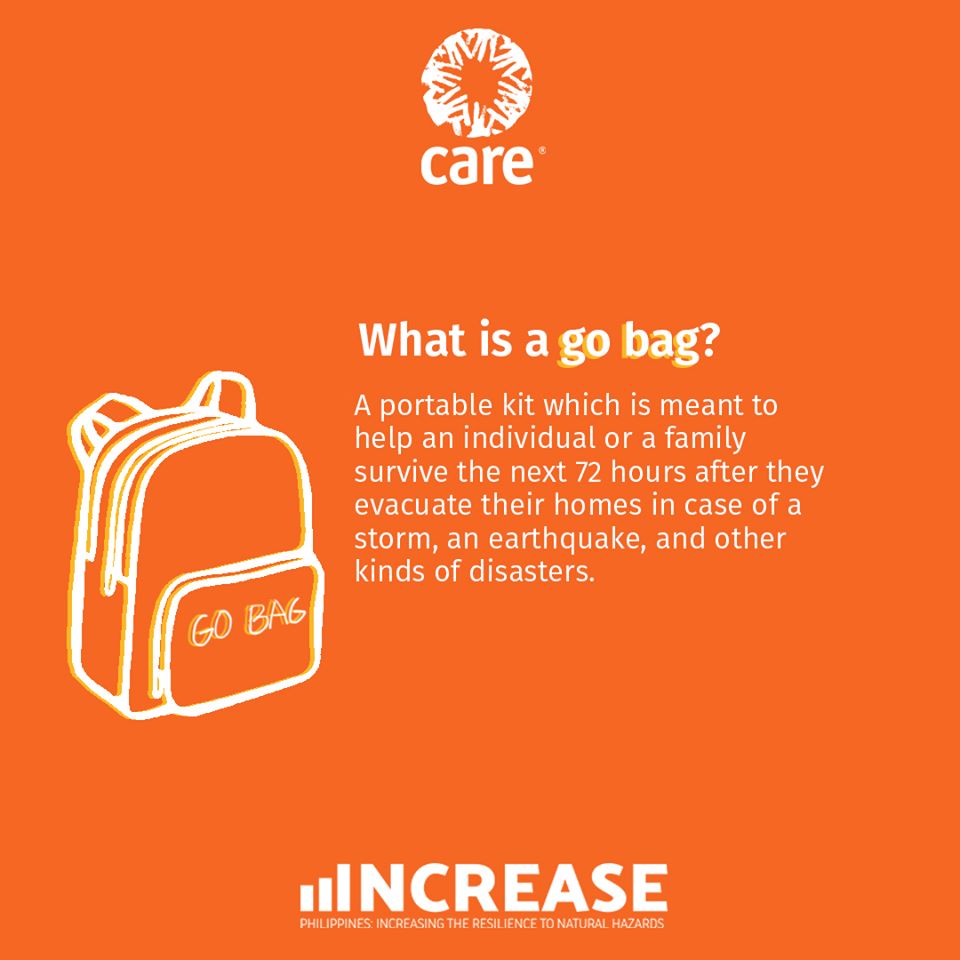
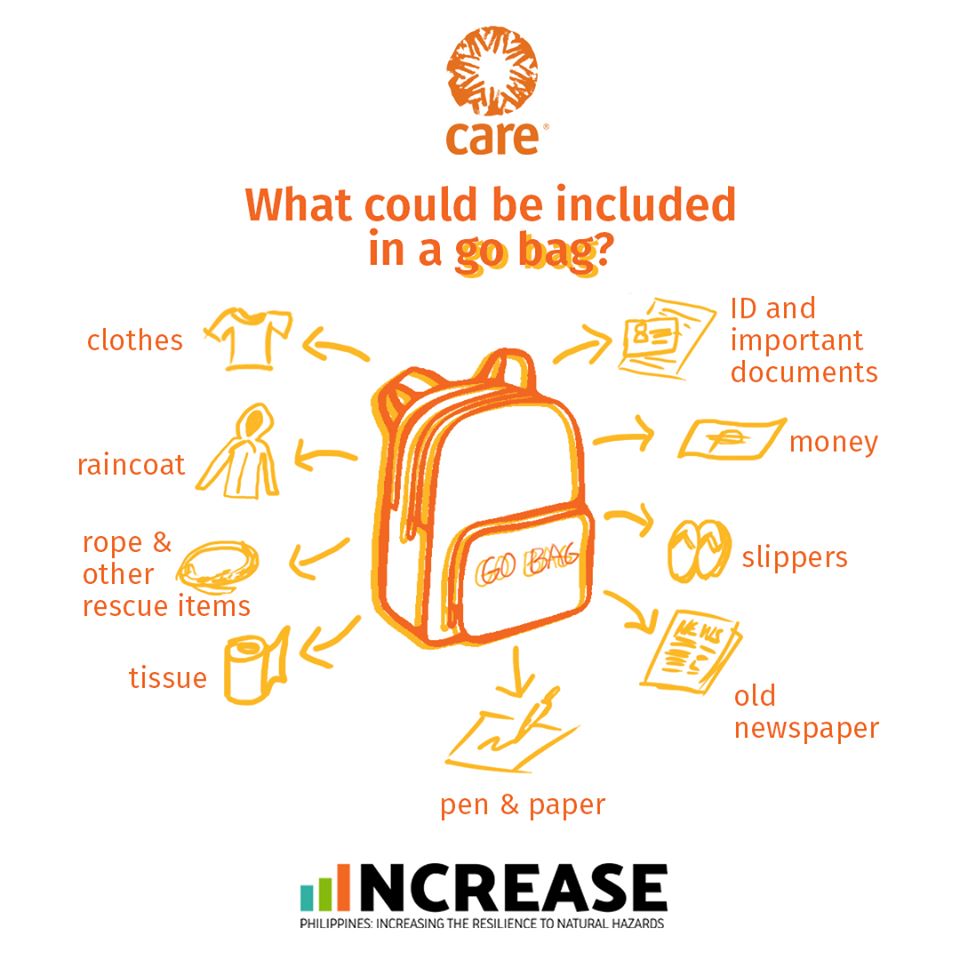
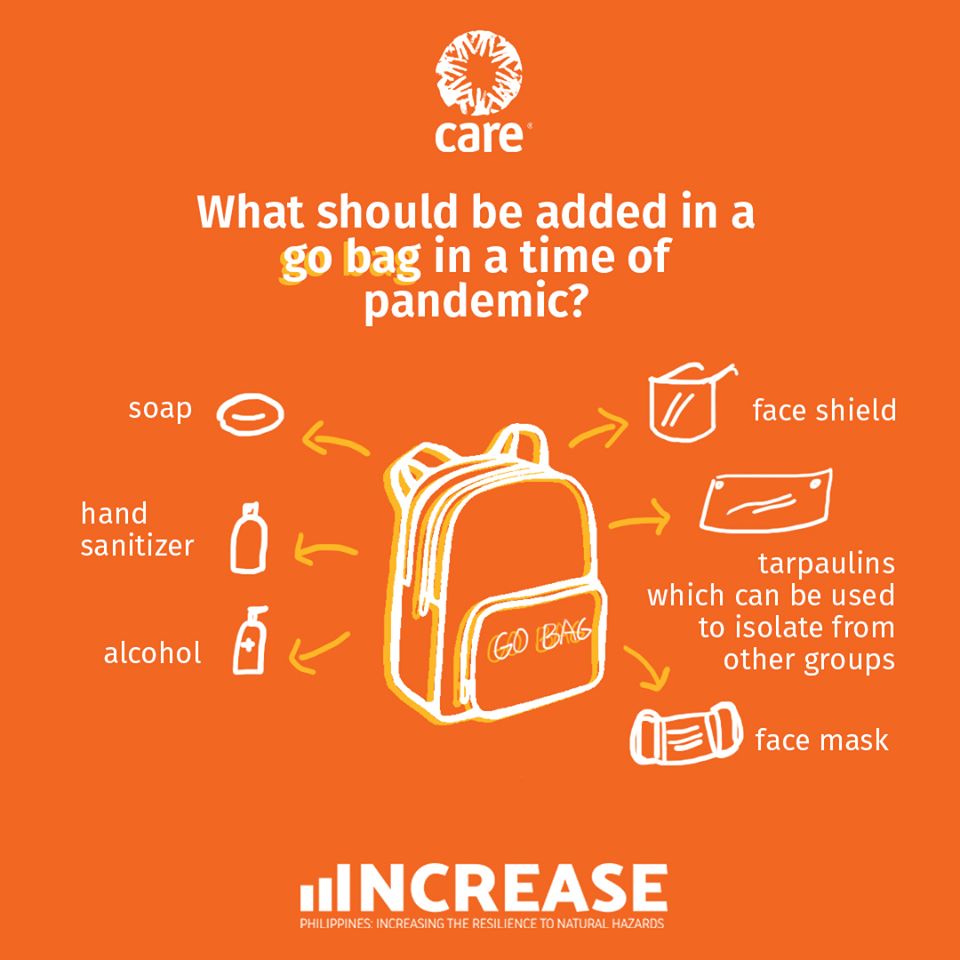
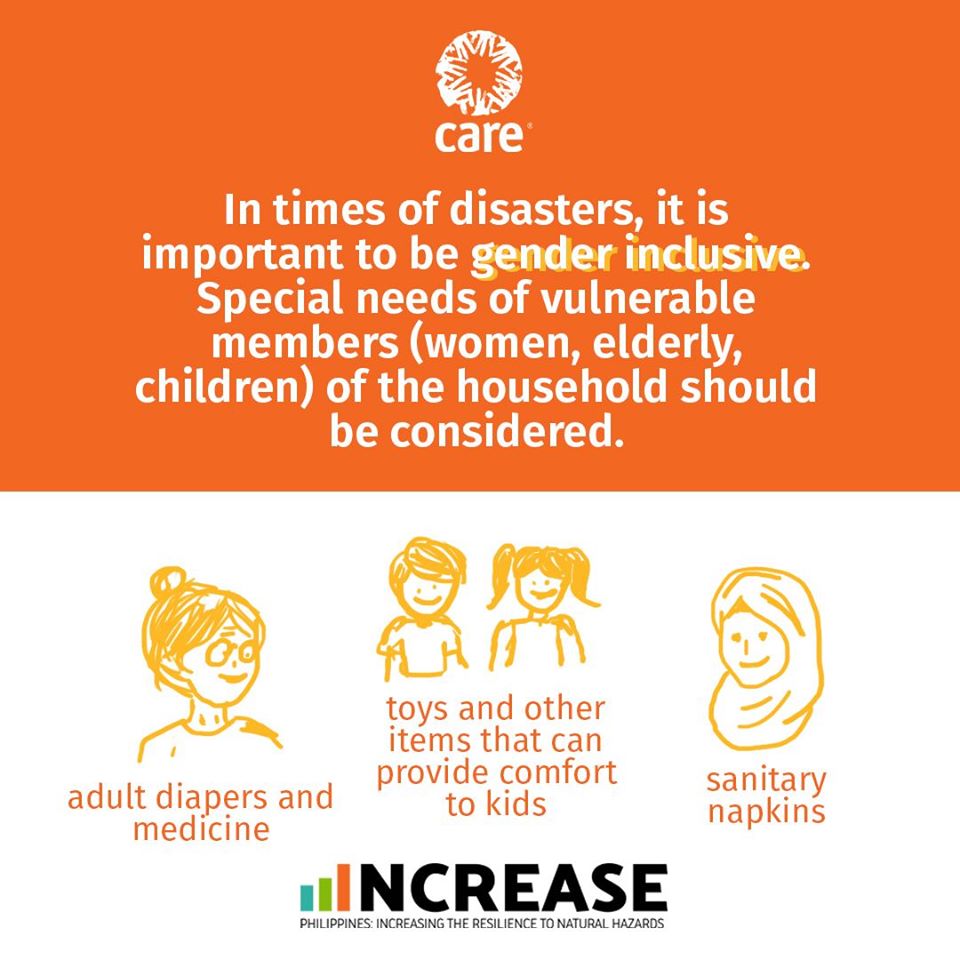
In the Philippines, a disaster can strike almost anytime. With a higher risk brought by pandemic, go bags or survival kits come in handy. While the usual inclusions of a go-bag should be prepared, water, sanitation, and hygiene (WASH) materials and gender-inclusive items should also be considered to make sure no one gets left behind when a disaster hits your community.
Check out these social media cards produced during this year’s National Disaster Resilience Month which had the theme “Sama-samang Pagsulong Tungo sa Katatagan sa Gitna ng Bagong Normal“:
Increasing the Resilience to Natural Hazards (INCREASE) aims to increase the resilience of 45,000 women and men small-scale farmers and fishers, including 720 extremely poor female-headed households, to natural hazards and the effects of climate change. It is implemented by CARE with support from the Skala Initiative and Phineo, in partnership with ACCORD Incorporated, Cordillera Disaster Response and Development Services, Leyte Center for Development, Inc. , and Agri-Aqua Development Coalition (AADC).